

In “What’s happening on Jan 13th?” I talked about bringing my internet friends Suntzoogway & Lukas Hammarström to Ithaca NY to help me figure out next steps for my work. They are now here, and I’ve been integrating them into my IRL community.
One project I pitched last week to this community, as a concrete example of what an “alignment institute” might work on, is: “why not dot com”
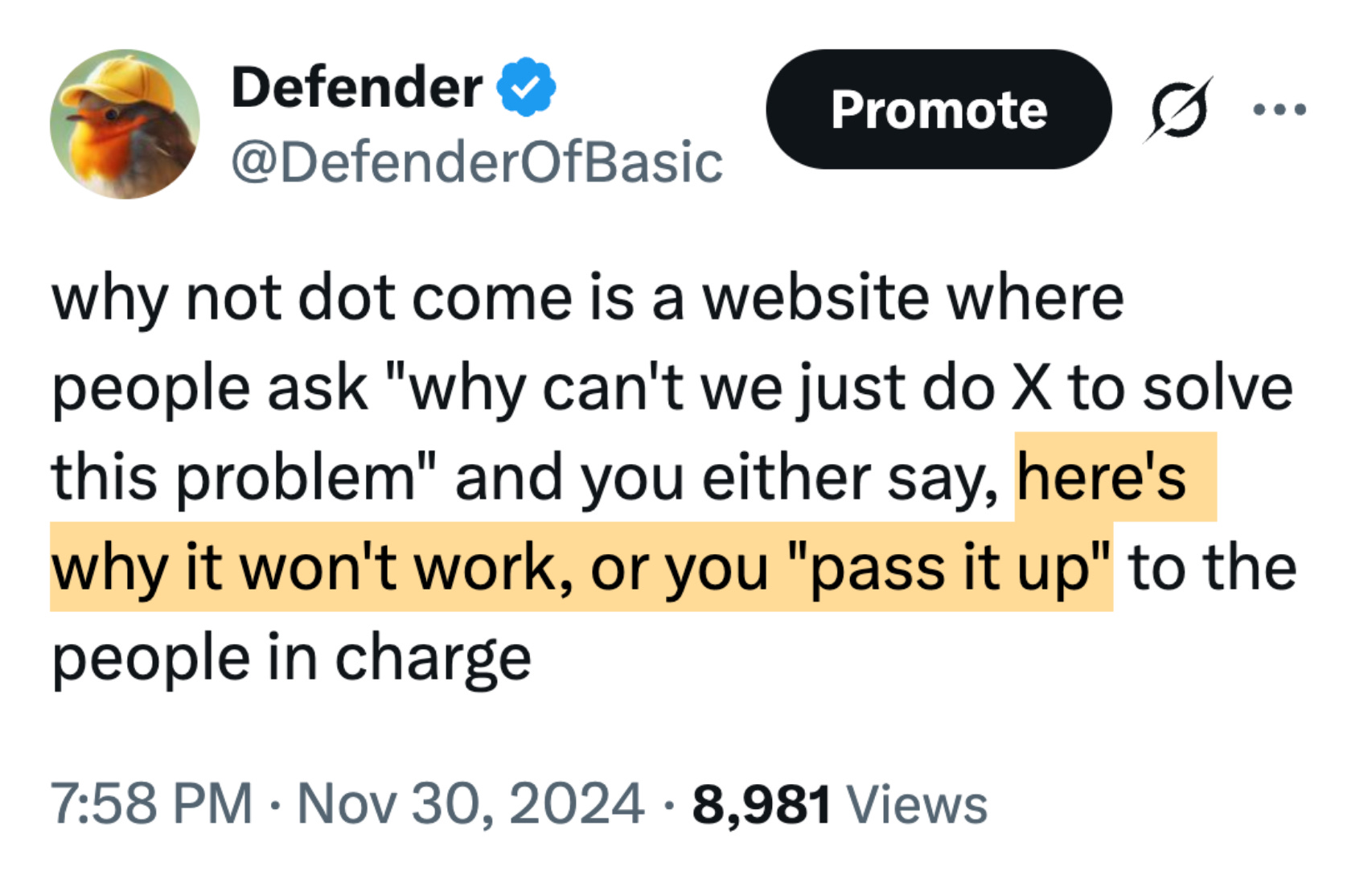
“Why not dot com” is an example of a “win win win” / positive sum technology. It’s positive sum because it benefits all actors who interact with it. It’s “triple win” because the third actor it benefits is the environment (it has positive externalities to even people who aren’t interacting with it).
You go to this system and ask something like “why can’t we just solve the economy by printing more money” or “why can’t I just fix the potholes on my street myself”. There are 3 possible categories of answers:
❌ There’s a good reason why this solution cannot work
👍 It’s actually a good idea, and someone is already working on it
✅ It’s actually a good idea, and no one has done it…yet!
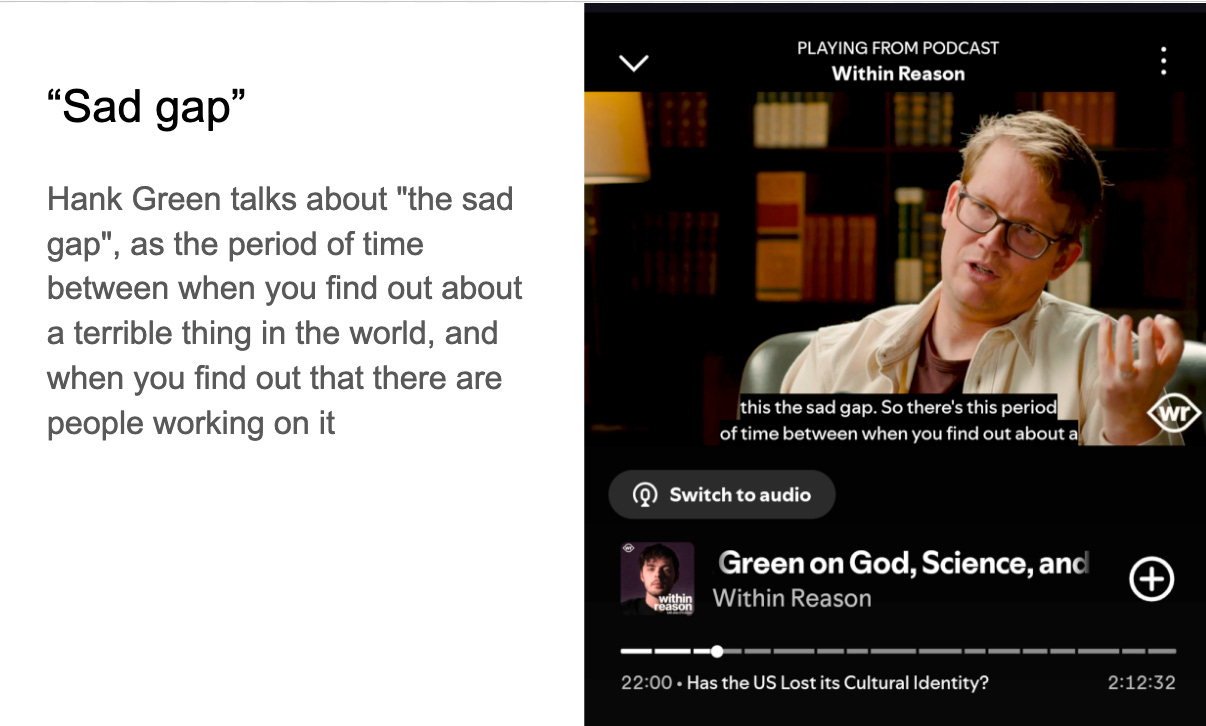
In ALL cases, you benefit from using this system. Even if 100% of your ideas are bad, you calibrate your expectations of what is possible in the society you live in & rely on. It systematically allows people to cross what Hank Green calls “the sad gap”.
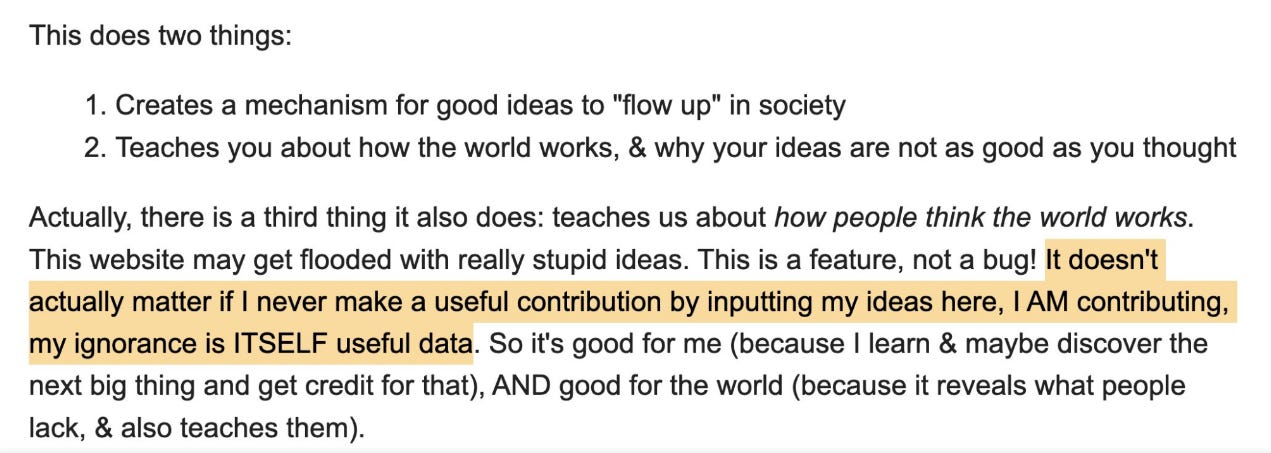
Even if 100% of your ideas are bad, you using this system creates a positive externality for people who are responsible for moving society’s resources around - because they get to see how people THINK the world works/what solutions they’re expecting. It calibrates in both directions.
I never built this website because at its height, my twitter + IRL network functioned as “why not dot com”. This is one way to explain what I’ve been doing all year: repeatedly asking “why not”, even if it sounds really stupid. Either the idea/pitch would blow up until it reaches the right person, outside of our network, who could explain & thus shed some light on how the world works, OR, someone would go and actually do the thing, make the app, start the company, do the local initiative, etc.
The end result of this process is that you get an accurate model of how the world works, and teach everyone you interact with something useful along the way (either they also learn about the world with you, or they learn about your ignorance, which is a useful data point). If you keep doing this, you eventually DO get to something that you can contribute, that no one is yet doing. You find your place.
That’s when I started thinking about both (1) open memetics and (2) the Open Research Institute. The open memetics part was about creating this network for everyone that can cover “one of each”. And the “open research” part was about doing this kind of “internet phd”, learning about how the world works until you find a novel contribution you can make.
One thing that becomes obvious from this process is that we’re stuck in many lose-lose downward spirals. I saw this great example yesterday, where film makers hate that movies have to be “dumbed down” now because of shorter attention spans, but those dumbed down movies lead to shorter attention spans, and on & on.
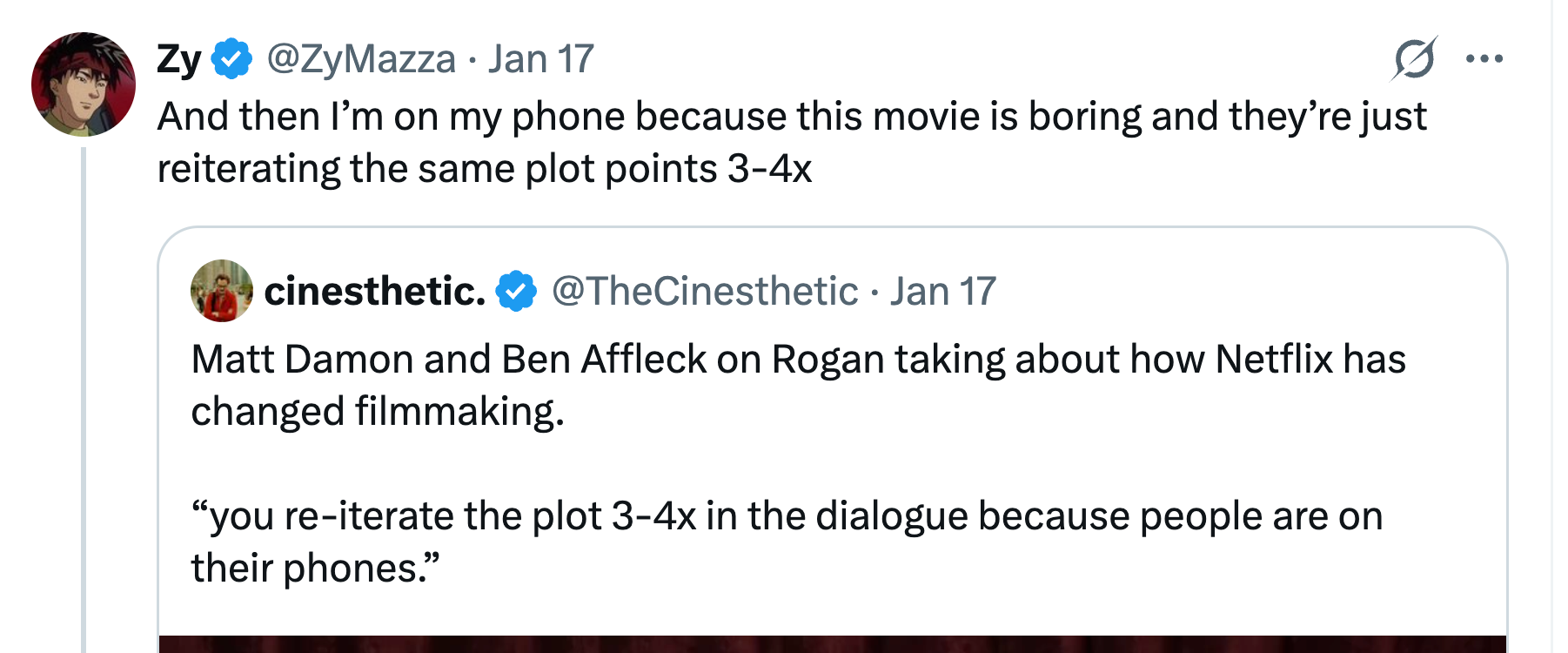
This is really important: let’s say you as a consumer really hate this trend. You WISH someone would make a movie that isn’t another sequel, that is original, with lots of depth & craft. But let’s say they actually did it! Did you hear about it? Did it end up flopping because not enough people paid to watch it? Would you have watched it with your friends if you had known that this was the attempt at breaking the downward spiral that everyone is complaining about1?
One thing that became clear to me as I was trying to explain all this to friends, Lukas, and Sun is that it’s still not clear to people what it looks like for a world where open memetics succeeds at its goals. I think I can spell it out more clearly. For now I like to think of this WKUK sketch where a high school students asks a simple question about how the world works:
The teacher doesn’t know, so he asks the principal
The principal doesn’t know, so he calls up the mayor
The mayor doesn’t know! So he calls up the army guy
The army guy doesn’t know, so he calls up the president
The president takes an action based on this question reaching him

This is a very clear goal to me, and measurable. We could continually measure how close we are to this world, where your questions “bubble up” until you get the answers you need, or see the change happen. We can measure this at the scale of communities, companies, and countries.
Ok, so what “company” am I actually starting here? I don’t know yet. I feel like there are a lot of specific lucrative things that have come out of this work, that we can focus on as a way to fund the rest of it on an ongoing basis. I was thinking of putting up a “services offered” page on the Open Memetics website, where a few services would be “scouting”, “marketing”, and “credit disputes”. This is some of what I do on a day to day basis, I use this information network I’ve been operating to help people find a job, or get a kind of “background check” on someone they want to invest in. But I don’t really want to get paid to use the network, I want to get paid to maintain the network so that everyone can use it. If you have to pay me to manually find information for you, that’s a “bug” that should be solved at a system level.
I appreciate both Lukas & Sun - the latter has been indulging me in thinking about “big big picture, the best possible world”, and the former has been pushing me to simplify, make it concrete, “what are we actually doing here, explain it me in plain language, who are we actually helping here”.
Sometimes it feels like the amount of work I need to do is enormous. And other times it feels like there’s actually only one high leverage thing I need to do, to operate directly on the bottleneck that everything else is stuck on. And the majority of the work is in finding that bottleneck. Right now that bottleneck feels like being able to see the flow of resources & information in the whole system, to map how decisions are made, so we can all debug it & find our place in it.
I finished reading Blaise Aguera’s new book last week. One thing that really stuck with me is his chapter on “efference copy”. He explains that neuroscientists used to believe that all decisions originate in the brain, but it seems that maybe sometimes, the decision to move your hand originates in your hand, and it just notifies the brain what it decided to do (what they were thinking of as “efference copy”, like the hand sending back a copy of the signal it receives, maybe isn’t a copy after all, but actually the original decision signal):
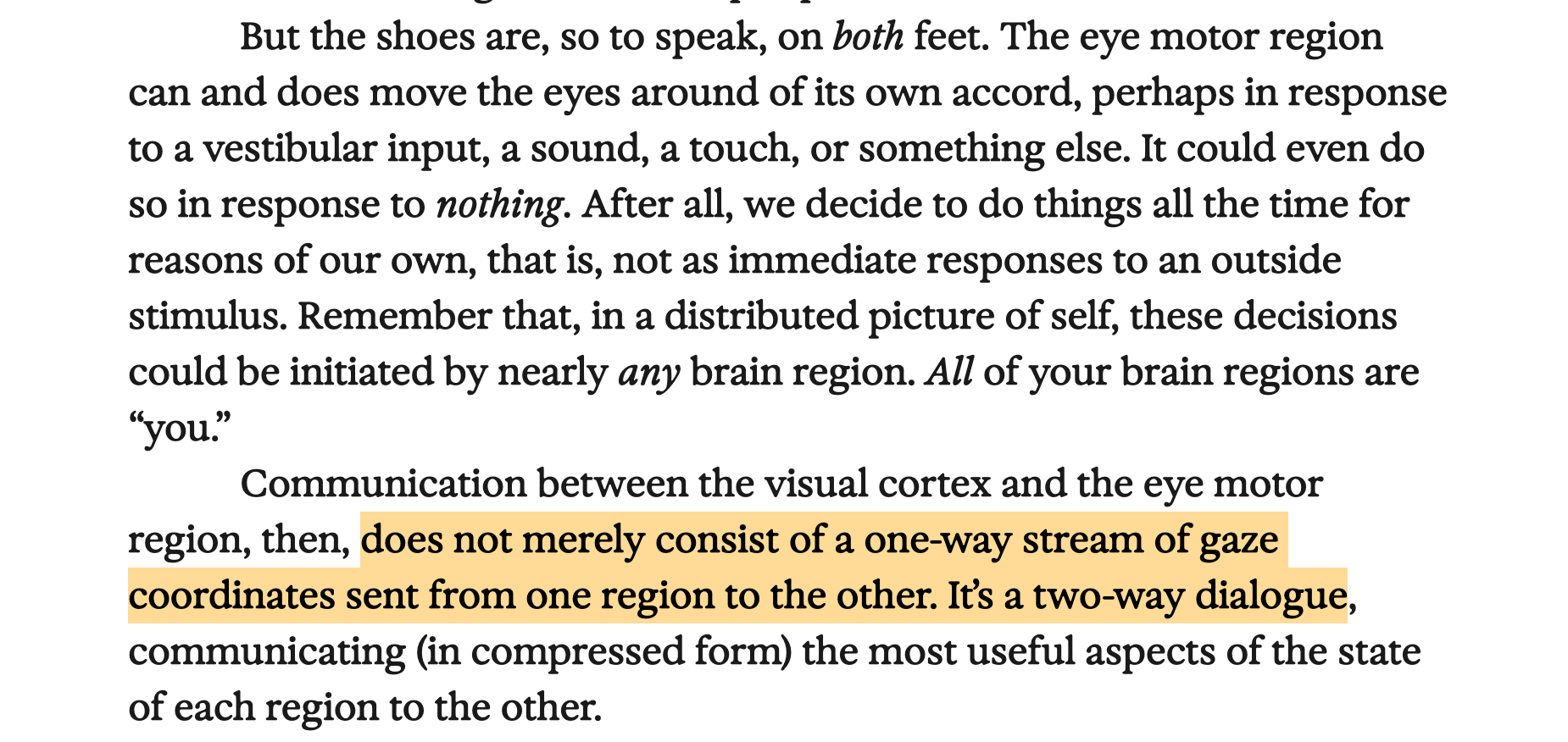
I like to imagine society being capable of structured in a similar way. That when I encounter a problem here in Ithaca, I can bubble it up to the person in Ithaca who can solve it. And if actually, a lot of other small towns across the country have the same problem, then we can solve it, and then write about it, and those other towns can copy the solution & adapt it to their environment. And if the problem hinges on a national/global scale action, that it bubbles up until those who can take the action see that, explain why it’s not possible, or it just becomes visible who the bottleneck(s) are.
In this world, the presidents, or CEOs of the world don’t make decisions top down, they mostly coordinate. And I think the good news is that, as far as I can tell from a little over a year of running virtual “why not dot com”, this is already how decisions get made globally in the world, it’s just that most people don’t see how their day to day decisions propagate across the superorganism.
And I think the trick is making this visible without complete chaos ensuing. If we can survive that transition, I think it’ll be a really great time. Imagine seeing the question you asked start this firestorm of discussion, and what actions that then leads all around the planet. And this data stream being 100% voluntary opt-in.
It’s possible that you might know all this and still choose not to spend your money on it - in that case you realize that this isn’t a high enough priority for you. And that’s GOOD! Now you can stop complaining about it / feeling like the downward spiral is out of your control. Nothing has changed in your behavior, but the quality of your life & your relationship to the world has improved. You now have an accurate model of the problem & your relationship to it.
This is why “why not dot com” isn’t (just) about surfacing solutions, it is about calibrating your relationship to the problems that you care about.
Your world model seems to be missing something very simple, correct me if I'm wrong: why would the principal, or corporation etc, care about the person with less power? The answer is: THEY ALREADY DO CARE! They are spending enormous amounts of money trying to convince them of certain things (propaganda), and when the public opinion doesn't go their way, that destroys (1) the company (2) the politician, etc.
I don't think you understand what this is - which is why your words are unconvincing (and feels good because it gives me greater conviction that there's no good reason why this won't work). The "what's happening on Jan 13" maybe gives you more context, but you have to think of this as an "open intelligence agency". It doesn't work without the scale. If you have the scale, you have influence. This isn't a "I hope people in power do the right thing" thing. This is "everyone in power wants to use this thing, because it lets them shape the narrative" (and that includes people down the power ladder fighting the people one rung above, and below). Coordinated power one rung below beats uncoordinated power one rung above.
(If they're both coordinated maximally them the rung above wins. But part of the foundation of this theory, and don't laugh, I'm serious: coordination is love, so you can't be coordinated, with power, and "not care" / do harm without creating a way for someone to usurp you. I wrote about this in the "assymetry of good & evil" post)
Why do you assume the experts above you want you to have the answer
Their existence depends on generating new complexity for you to struggle with