
Good morning, ORI!

ORI stands for “Open Research Institute”. It is my favorite egregore (network of humans) that I’m in.
Some people have been part of ORI for almost a year now, others are just joining now. The earliest reference I can find for it in my twitter is March 3rd1. This post is for everyone in ORI, or who wishes to contribute to it.
What is ORI?
A network of humans bound by a culture, designed to function in a specific way.
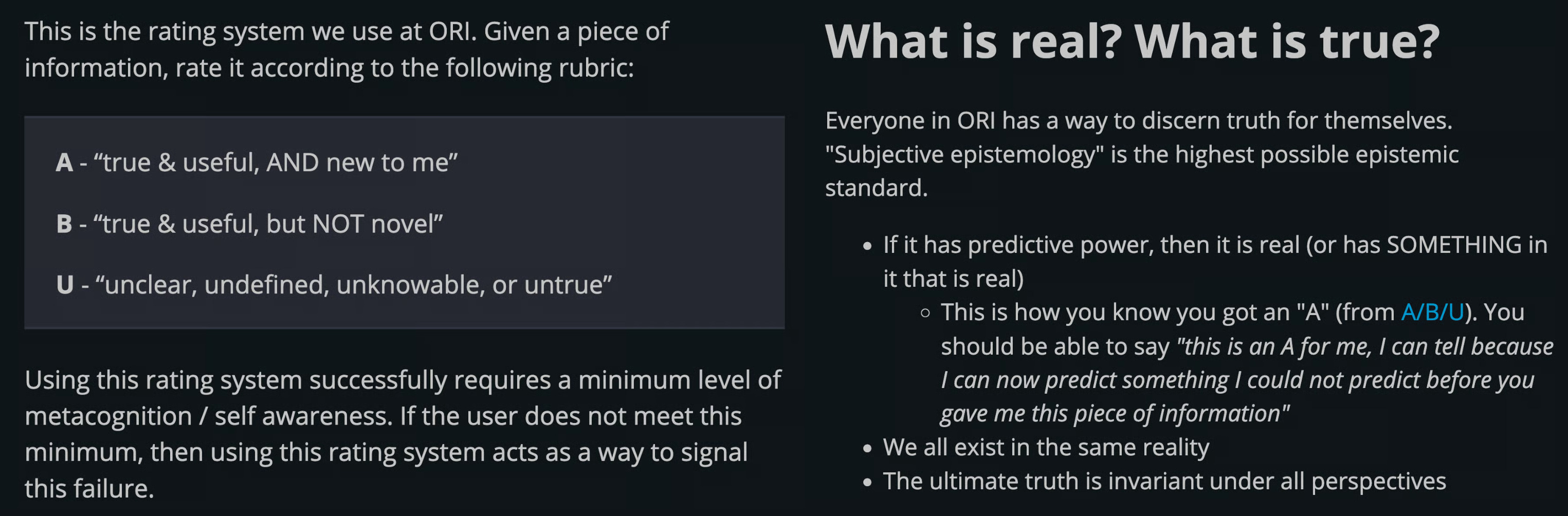
This morning I wrote down what I think is the “minimum” set of language you need to participate in ORI. I settled on these two concepts so far:
You have a process for discerning truth, directly, for yourself
You have enough awareness of your world model to recognize when it updates
What is the purpose of ORI?
When I say ORI was “designed to function in a specific way”, I am referring to its purpose. I define ORI as:
the egregore inside of which your learning rate about reality is the fastest
Given this definition, you can see how “an ORI” exists for every human2. The ORI that I am working on is the generalization: what is invariant when you consider ALL ORI’s, for all types of human minds. I think the two principles above are probably in there. I think “destigmatize being dumb” is probably a necessary prereq3.
Another property that I think emerges if you build ORI right is that you should expect everyone to be connected with someone “one step ahead” and “one step behind”.
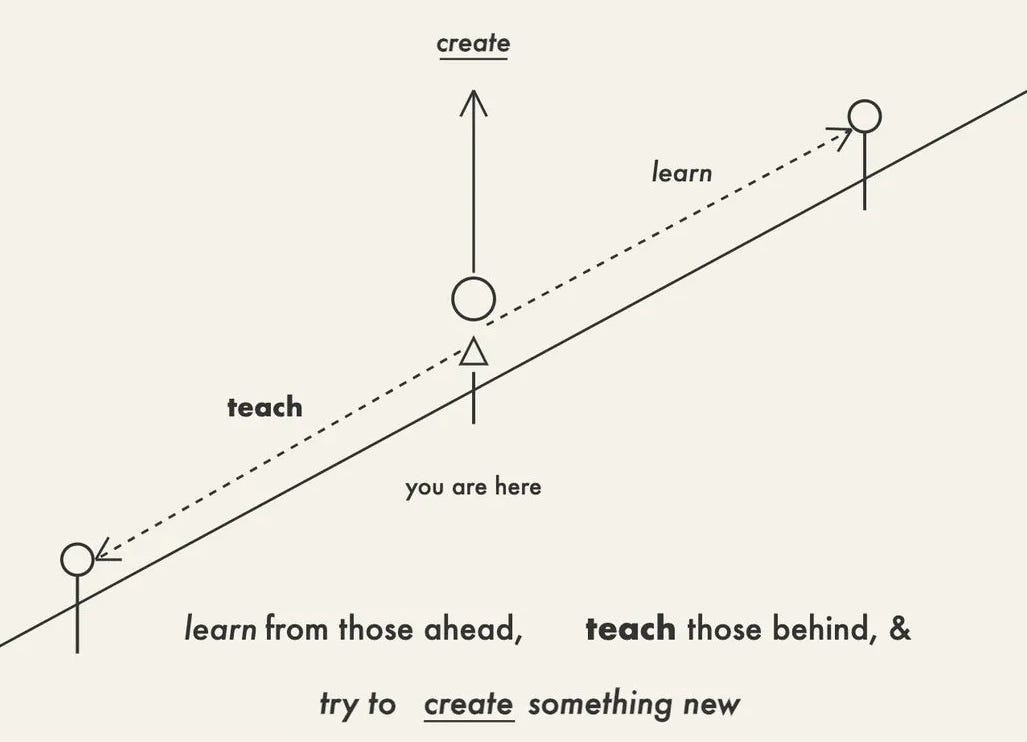
I think it’s obvious why you need to be connected with someone “above you, but not TOO far ahead” (it’s hard to learn from someone too far ahead). But why do you need to be connected with someone “behind” ?
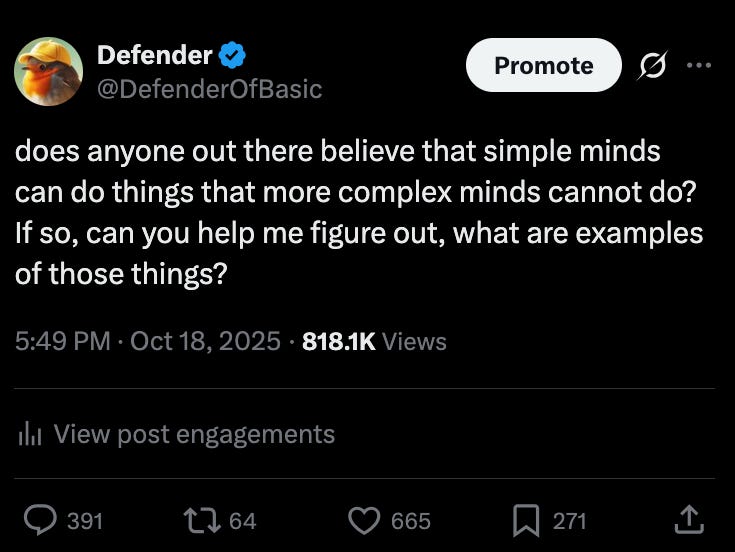
The answer to this question I think is quite deep, it’s something we’re still figuring out. Adam Mastroianni recently had an essay trying to articulate the value of “brainy folks” being connected to “folksy folks”. I posed this same question a while back that a lot of people had a lot of thoughts on, on why complex minds need simple minds (or, why smart people need dumb people):
The ideal ORI forms a chain from backtier outwards in all directions to frontier.
“knowledge for the backtier, grounding for the frontier”
If you’re on the frontier, this is very nice because you can focus on just furthering your knowledge, and someone else can do the work of executing it. If your theory is right, they make a lot of money and then (hopefully) pay you.
And you benefit from the positive externalities of a world where your good true knowledge is being applied.
What is on ORI’s mind?
One big thing ORI is trying to figure out is a “big picture” view of the superorganism(s) we live inside.
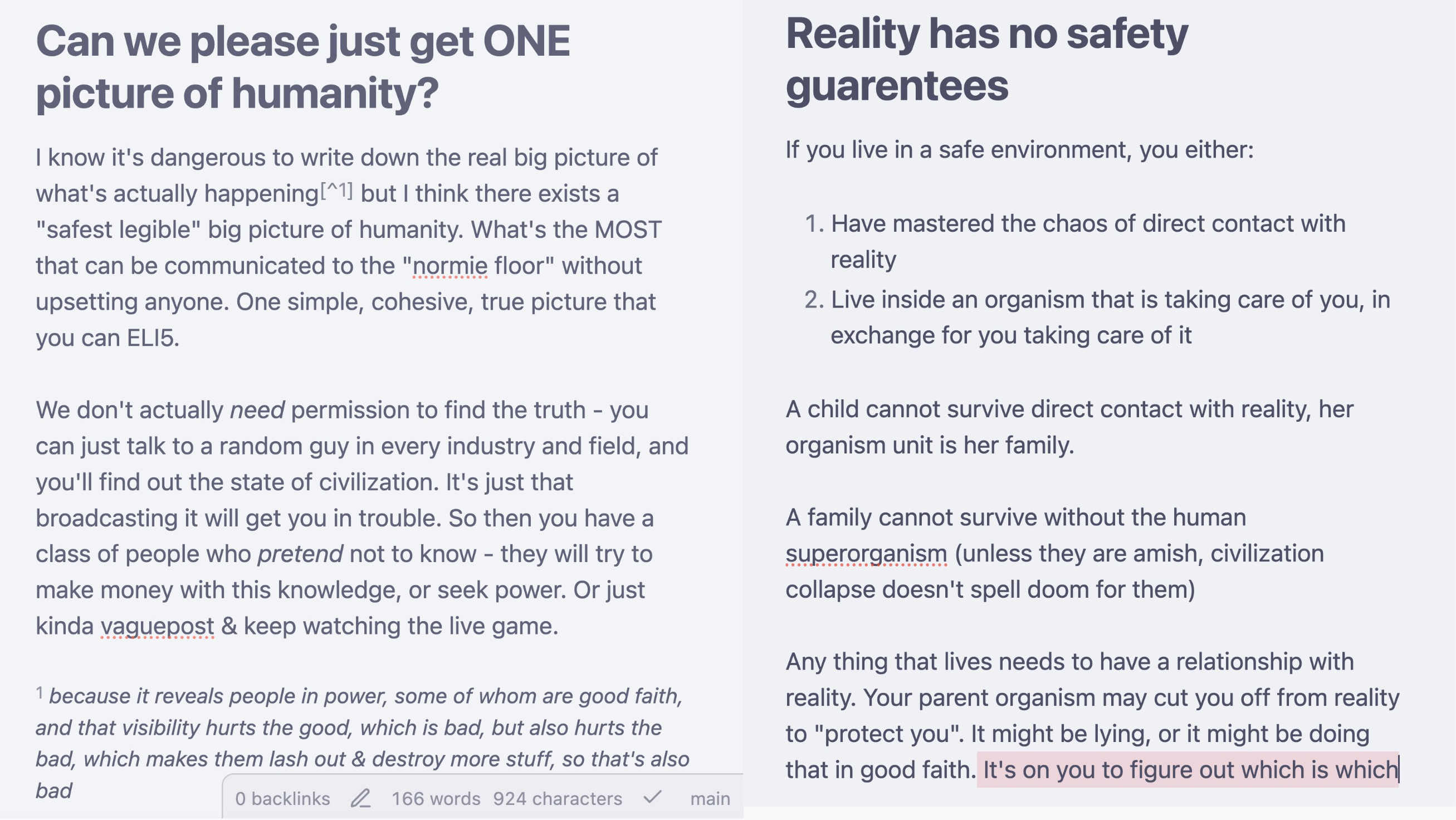
Ronen is one of the people I look to as frontier on this topic. Ronen is not part of ORI, in that he does not publicly endorse this egregore, but he is part of ORI in the sense that ORI is watching him, learns from him, and if it needs to, has a path to surface questions to him.
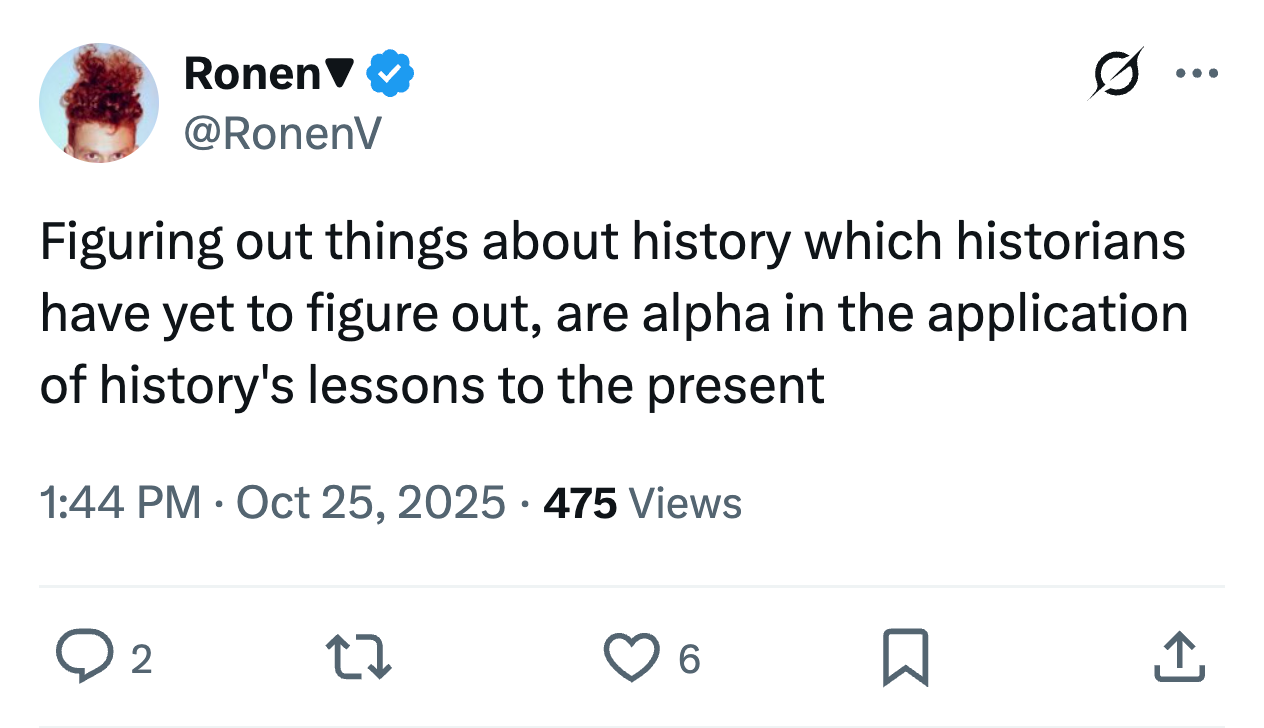
If ORI had a “google maps view” of everyone in knowledge space, Speaker John Ash would be a neighbor of Ronen, in that he’s working on similar problems and has independently converged on similar solutions from a very different intellectual path.
One thing ORI needs, that Ronen, John Ash, and Michael Garfield have all independently described is an information network where true things surface & a chain of attribution rewards those who called it early & helped it propagate. For now we’re doing this “manually” / as a cultural protocol.
One person building such a network is Ronen Tamari, the product is called “Semble”. This was recently awarded $1M from Astera Institute. I was delighted when he saw the A/B/U language we use at ORI and recognized its purpose.
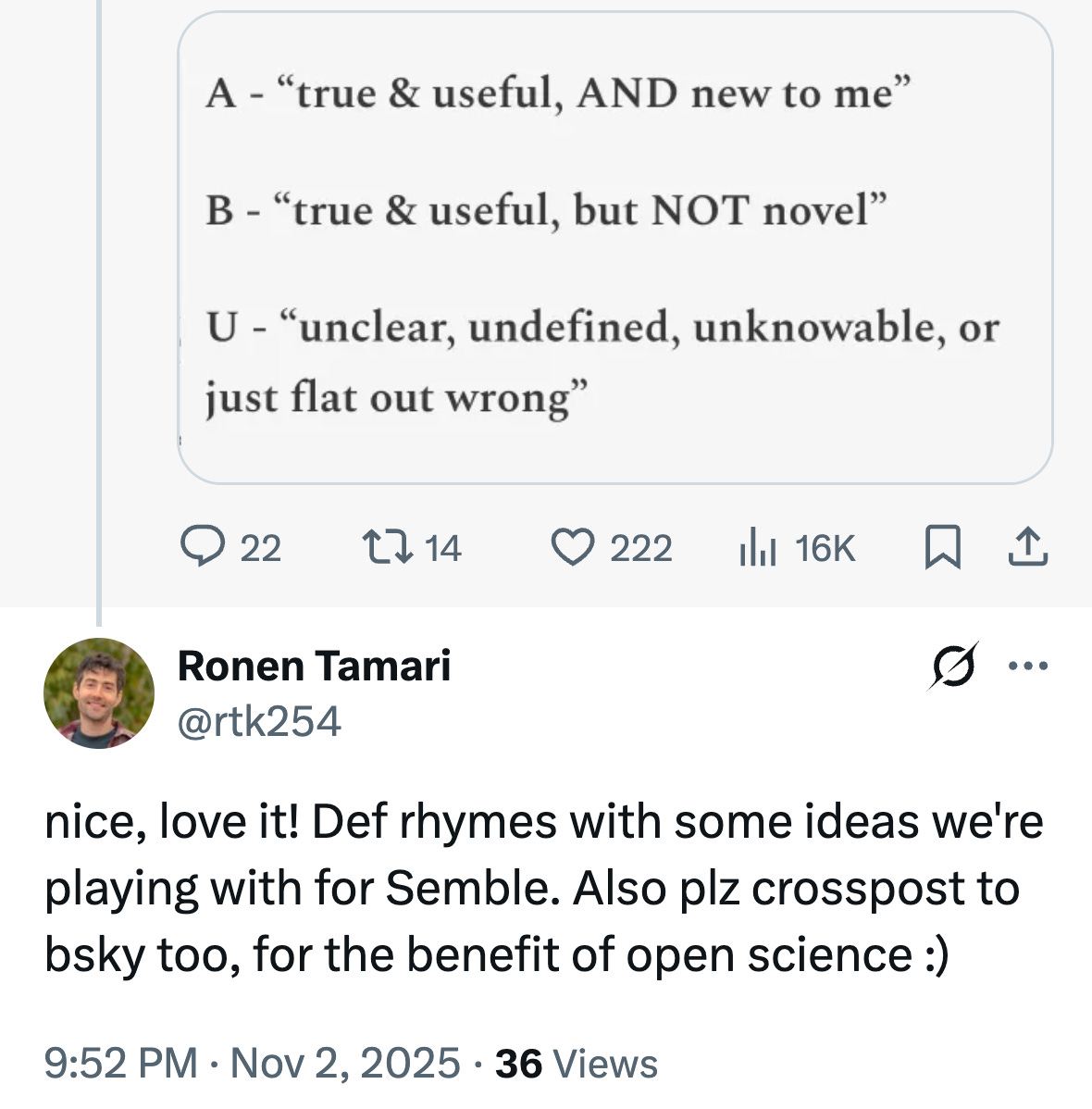
This is how ORI has been accumulating resources so far - we sit around thinking about what needs to exist, and if we’re right, we can find it already being developed & can just use it. If we’re early, we can catalyze its creation, like how ORI bootstrapped the Community Archive project which has now spun out & is run by Epistemic Garden.
What happens next?
ORI describes & writes down the optimal “truth generation & propagation” protocol. We’ll know it works if truths arise first within the network AND propagate outwards. This cannot work unless “dumb” people are part of the network, an unbroken ladder of intelligence that can compress truth losslessly.
In the meantime, the open memetics people are working on monitoring & debugging information propagation across all networks. They are the ones who will be able to see if ORI is the “center”. If not, ORI will simply study the center, and learn from it.
There will be a lot of money to be made along the way by whoever can successfully execute the pieces needed for this transformation. There will be a lot of value generated, a lot more than ORI is capable of capturing. This will be another sign that it’s “working”.
How do you join ORI?
EDIT Dec 16th: in one sentence, just write your manifesto/what you’re working on/whatever somewhere publicly on the internet, then use an internet wide semantic search to find your “neighbors in idea space”. Exa is a good tool for this. See video here.
(1) Just put “ORI” somewhere in your bio, on whatever social media you use. If you understand it, describe what it is in your own words4. When you see others who have “ORI”, you can expect them to at minimum know the A/B/U rating system. This means you can “calibrate” with them. You can binary search each other by exchanging A’s & B’s until you map each other’s frontier.
It doesn’t really matter where you start, you should be able to “go up” or “down” towards your peers, from any member as a starting point.
(2) Make an ORI profile. This is where you write about what you’re currently working on, and what you need (in terms of collaborators, or resources like attention, or capital)
We have been using GitHub for this, but Substack’s about page works too. Here is what mine looks like: https://github.com/DefenderOfBasic/. Here is another: https://github.com/faltz009/
Here’s a good example of an active research project that was incubated in ORI, and has recently been published at the Wolfram Institute: https://github.com/SASenchal/God-Conjecture. The nice thing about using GitHub for this is that all feedback can be recorded publicly. If Sam has responded to rebuttals about his paper over email, he copies it in here as “issues” on the repo that are resolved, so anyone new to the project can see the history and jump in to contribute.
The point is that if you see yourself in ORI, consider yourself able to get the attention of any category of human on earth. If you need the attention of a billionaire, investor, or specialist in a niche field, you can propagate it up the chain. You are part of the propagation chain.
If the resources that you’re looking for exist, you can assume that they’re looking for you to. All you have to do is make yourself easy to find. If you’re wrong (about the resources existing, or you having a good use for them), you will learn that.
First ORI tweet March 3rd: https://x.com/DefenderOfBasic/status/1896716975629598816 - for the first substack post, see April 21st “how do we boostrap ORI”
For any human, look for when they are learning the most - what group of other minds are they connected to in that state? For most adults, this is their workplace, or their friend group / hobby. Online communities like LessWrong & tpot serve this purpose for their members.
“Superlearning 101” by Ogi Ogas independently corroborates this - that “learning about how your mind learns” is one of the highest leverage activities you can do to accelerate your rate of learning. And that requires removing any shame around whatever faults your mind has.
Logan Jensen has been doing this, describing exactly what ORI is doing in the language of the research/master’s he’s been doing: https://www.loganjensen.me/i/180057102/what-ori-is-doing
Officially branded myself an open memetics researcher in my profile
immediately grokked!
prediction as the meta-epistemic grounding is not just where ORI stands but I think the solution to postmodern subjective observer malaise.
in short, all As, amazing, and I will add ORI to my profiles :)