
A Journalist is a Lawyer
there is no such thing as an "unbiased" or "objective" lawyer

You are in court - accused of a crime you did not commit. The judge says they’re A/B testing something new: instead of TWO biased lawyers, you have the option of ONE neutral, objective lawyer to represent your case.
Do you pick one unbiased lawyer, or two biased ones?
The correct answer is: two biased lawyers.
Because the objective lawyer spending equal time searching for evidence in your favor VS against you does NOT guarantee that he will find all the relevant facts.
Sometimes the piece of evidence that proves you are innocent requires 10x as much effort. At what point do you stop searching? What you want isn’t someone who “follows the evidence” objectively and reaches a conclusion. You want someone who ASSUMES the conclusion is already true, THEN goes around searching for evidence.
And then you want someone to look at both attempts, and judge.
When I hear a journalist say that they are objective & neutral, I think:
They are lying, and are trying to manipulate me
They are unaware, and are incompetent1
If there is one truth I could propagate through all of society right now, I think this would be a top candidate. Consumers understanding this improves their ability to find truth. Publishers normalizing this means they don’t have to play this charade of pretending to be objective (and it neutralizes one manipulation tactic)2.
If an Open Memetics Institute existed, this belief / meme would be something that they might fund as a public good to spread in every network. Like putting fluoride in everyone’s drinking water3.
The good news is: this idea is already propagating4! Publications like Tangle & Ground News use bias to surface truth instead of trying to eliminate it. Today I became aware of this billboard in Egypt which says:
Do not trust the news…
…if it does not show all perspectives.
Trust is earned.
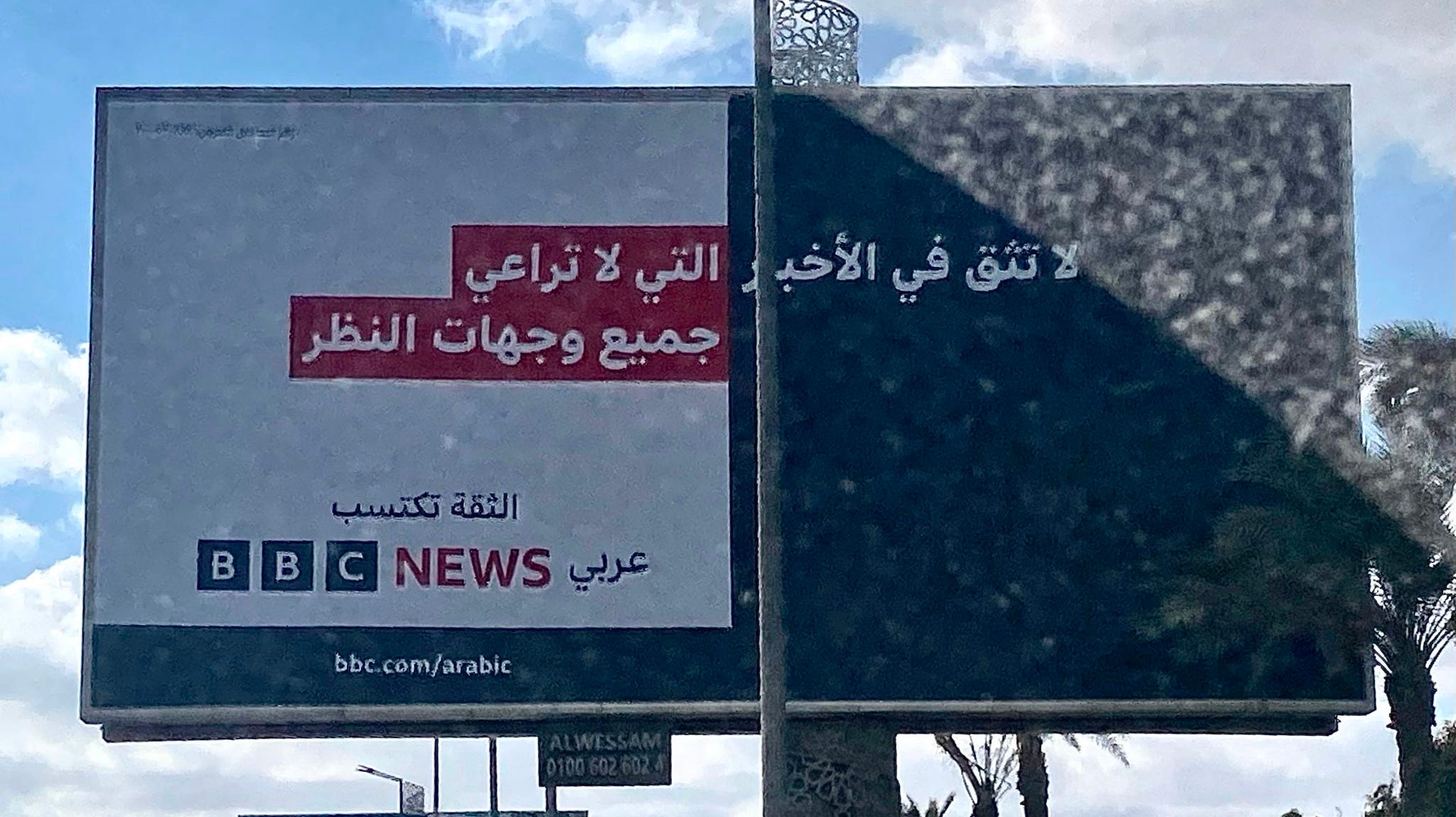
This is a beautiful, pro social ad, of the kind I dreamed about a year ago when I wrote about “the best ad I’ve seen all week”.
The “Anatomy of an Internet Argument” project is about everyday people practicing being better lawyers for their side, which helps everyone (even if their side is wrong).
This concept doesn’t just apply to law, or journalism. It applies to any truth seeking process, which includes science.
In science, it is good to collaborate WITHIN the paradigm. And it is necessary to compete ACROSS paradigms.
Today, the state of competition in science is more like it is with journalists. To understand how ridiculous this is, imagine if the jury decided not to listen to your lawyer because the other lawyer called him biased. Or imagine if you couldn’t create a startup to compete with Google unless you got permission from Google.
It is possible to transition to a more fair, open competition in science. We cannot get there without growing our ability to judge & discern. Otherwise the paradigms that actually work & produce results will not win. You don’t just want lawyers & plurality of opinion, you need discerning judges. You need to be a discerning judge.
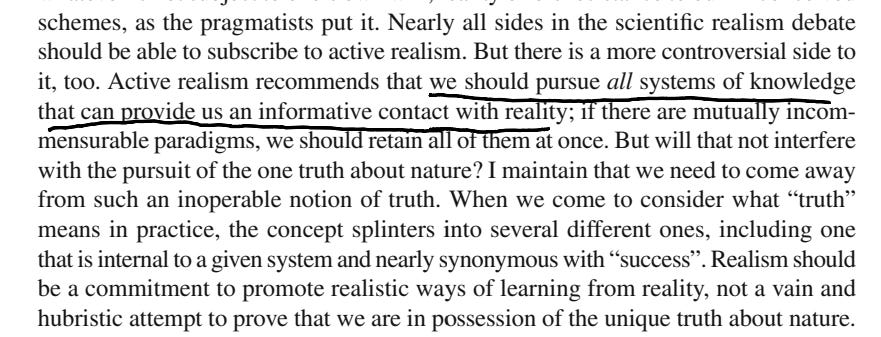
I’ll leave you with this piece from the book “Is Water H2O?” that has been a recurring paragraph that I quote a lot:
we should pursue all systems of knowledge that can provide us contact with reality (there doesn’t have to be just one dominant paradigm)
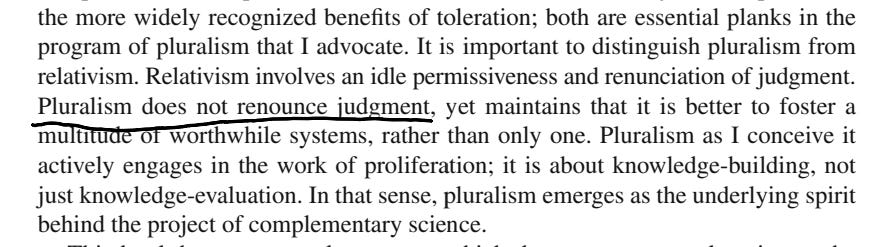
Pluralism does NOT renounce judgement
I want to make it really clear that BIAS IS A FEATURE NOT A BUG. I don’t want a lawyer who half-asses representing the other side. I need them to have skin in the game. They need to actually win something tangible if their side is correct. Like I want my journalist to also be an investor in the company they’re reporting on (that way, I trust they actually want it to win), and then I also want someone who is invested in that company losing. If I can find these two people, then I can trust that I can judge between them and find the truth I seek.
I think there is an undercurrent of journalists who are trying to move away from the “objective” frame, but I don’t have any insider knowledge there. Independent journalists who did not go to journalism school are free from this restriction, but many traditional journalists still need to uphold objectivity, even as it sometimes gets in the way. Like when they have firsthand knowledge / are close to their community but can’t use that network/surface that information.
I hope the idea of a “organization that choose what ideas to propagate in society” makes you feel a bit uneasy. It is something that could be used for great benefit, OR for enormous damage. The philosophy of open memetics is increasing awareness, so that if dangerous things are happening, you can protect yourself (whether the people doing it are “open” and “benevolent” or they are doing it in secret). As the public’s awareness and discernment increases, it allows us to do more ambitious experiments. You can’t have informed consent if people don’t understand the consequences of propagating a new belief or meme. I talked a bit about “the big picture” this week with Guy who gave his recap here. And also in a recorded twitter space with Marianne here: https://x.com/DefenderOfBasic/status/1988346601560035592. I am trying to get better at describing the big picture.
In general, if an idea is actually good/true/useful, that gives it a bit of a bias towards propagating naturally in society. So, we don’t actually need to do that much “artificial” engineering. Unless there exists incentives for these good ideas to NOT spread, then we should debug and unblock that.
Related: see the “push vs pull” principle:
This is the fundamental principle of open memetics: we want ideas to spread via “pull”, not via “push”.
If you expose someone to an idea, and they refuse to adopt it, this is valuable feedback. You may believe the idea is good for them, and maybe you are correct, but why don’t they see it too? This is a useful puzzle to solve. You either learn that actually, it’s BAD for them, OR they misunderstood it, and now that you now that, you can spread it even faster.
Spreading via “push” is easier if you have power/resources, but it is less stable. It degrades the hosts’ epistemology, and you don’t learn as much.
I was going to say something about how it's ironic that Legal Eagle, big law youtuber, made a video saying "this channel is biased" (https://www.youtube.com/watch?v=1leFwYSUHQ4) but instead of owning his bias and telling people to listen to the other side too, he framed it as like, "we're biased towards THE TRUTH"
Rewatching it again now, I don't think it's as bad as I originally thought. I think I was just hoping that he would his platform to propagate this important message, to firmly state that you should NOT trust anyone who says "trust me because I tell you the truth, unlike the other guys". It's fine to say "trust me because I'm correct. You will see that for yourself if you listen to the other guy"
> If an Open Memetics Institute existed
Someday… 🥲