
⚠️ Infohazard vs 💖 Infoblessing
How to distinguish between bad psyops and good psyops

Yesterday someone asked me: why are you hosting an event in September where you’re not only teaching people how to manipulate information, but asking them to practice it, AND rewarding this behavior?
My answer is: the solution to an internet flooded with bad psyops is flushing the system with GOOD psyops.
What does a GOOD psyop look like?
A psyop (psychological operation) is a plan to get information into the mind of specific target(s), with a goal of triggering an intended outcome.
⚠️ A BAD psyop erodes the target’s agency (like tricking them into buying something) or produces epistemic noise1. 💖 A GOOD psyop increases the target’s agency (improves their ability to make their own decisions).
Do you have an example?
Here’s the most basic kind of objective that I might suggest to a beginner team at the September Event.
You find an existing operation out in the wild (engineered manipulation, or an organic false narrative etc)
You investigate & design a plan to counter it
You perform it & post-mortem what you learned navigating this territory
I spotted this last week in one of the areas I monitor: an official looking WebGPU twitter account that was surprisingly political, and hostile.
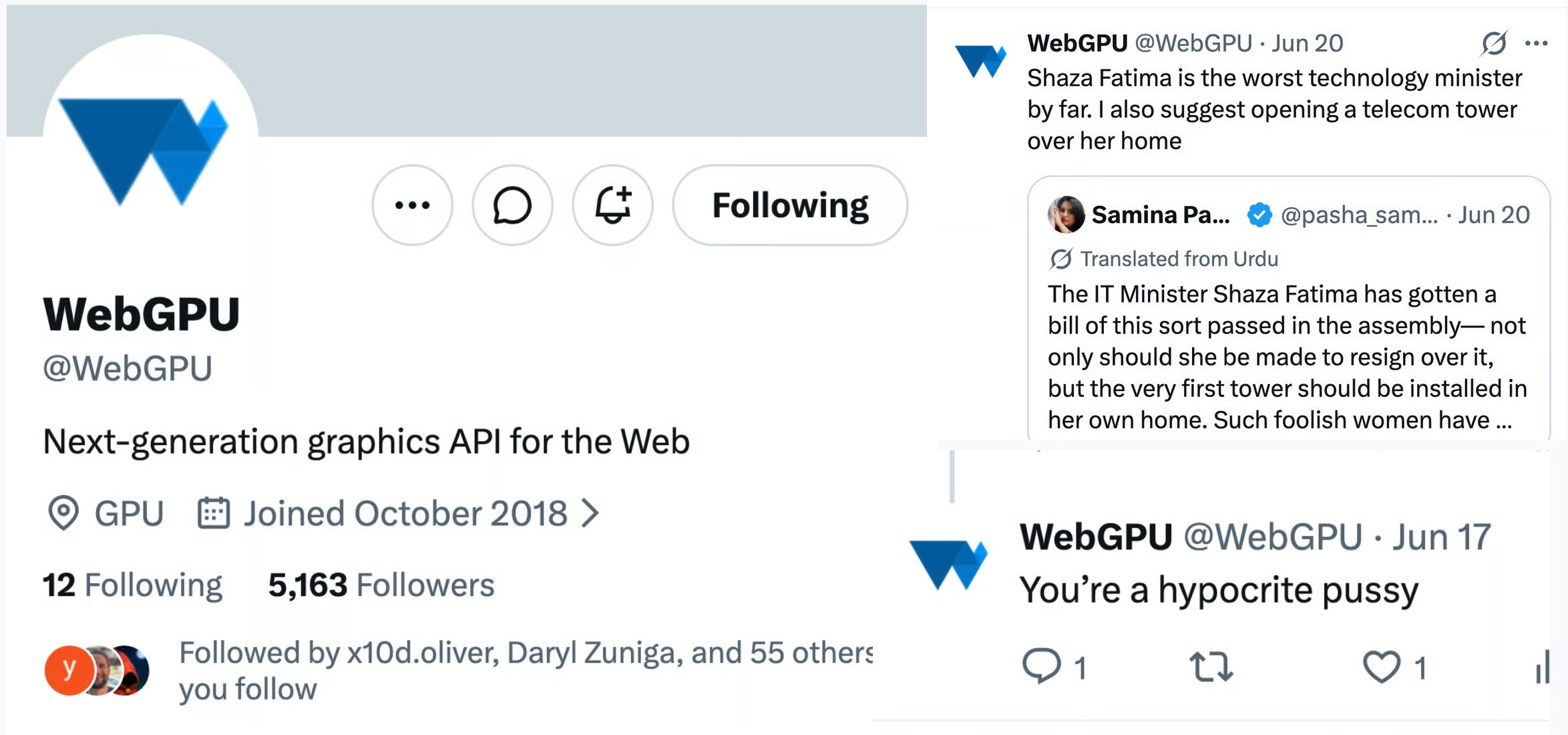
WebGPU is a big brand in computer graphics (it’s open source tech that powers a lot of 3D/video content on the internet). I and many others were following this account as an official representative of the WebGPU community.
I wanted to know if the community was aware of this & endorsed it. Step one is mapping the information landscape. I needed to know where the WebGPU community talk to each other so I can ask, or find a “cultural ambassador / lighthouse keeper” that I could ask to shepherd that information for me.
In this case I acted as the ambassador because this used to be my home turf. If this wasn’t my home turf I would go into the September Event discord where we have a network of ambassadors / operatives to help me get into that space.
Knowing the territory, I checked to see if this has been reported and found this:
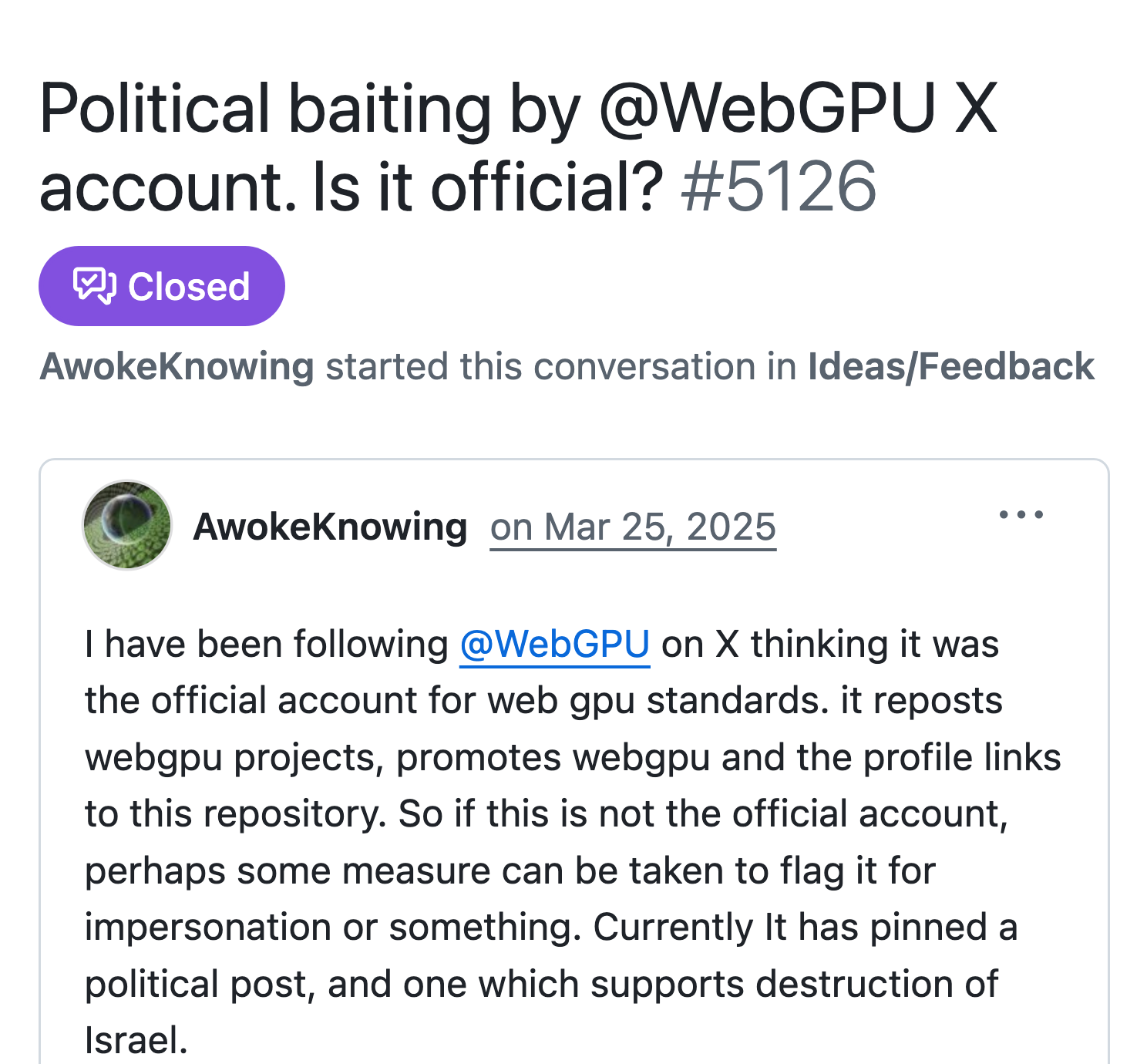
It turns out the organizers were in fact (1) NOT aware and (2) were linking to that twitter account from their official website. Once they became aware, they changed it so it no longer had that endorsement.
🎉 Success! That was a good clean up job. Documenting it maps the information pipeline here for future cases. It expands the “coverage area” of the open source intelligence community.
I call this a “basic mic check”. It is the simplest & safest psyop you can perform.
These are valuable even in small cases because they map attention & information flow. They give us empirical proof of what is and is not in different networks attention stream. The concrete proof is the behavior change. You aren’t dictating the behavior change when you do a mic check - you just predict that *a* behavior change will be observed when you bring the thing into their awareness.
A couple of other examples of “mic checks” that we’ve performed:
A small coffee shop had an issue (unmarked locked door) that many people complained about, and assumed the coffee shop didn’t care to fix. A mic check performed by an information engineer confirmed that the coffee shop did not know about the complaint - the proof being that the door issue got fixed.
Posting information in various places around the internet during an active New York County Supreme Court court case to check if it would be “heard” by the judge, or either side’s lawyers, and if it would lead to a more positive sum outcome for both parties2
Regular mic checks serve to test the health of an information environment, and can be used to connect previously unconnected networks.
The coffee shop example is one I keep coming back to because it’s an example of a “broken information pipe” that was assumed to be malice. A problem can go unsolved for a long time, or even trigger conflict, simply because of a blocked information pipe.
What I’m describing above here is one technique amongst a whole toolkit of positive sum social engineering techniques. The goal this September is to show people these tools, pair them up with operatives who have been doing this in the field for a long time, and have academics/researchers/journalists documenting the action as it unfolds. We want to get representatives from as many tribes as possible so that they can go back and use these tools to clean & maintain their own information environment as they see fit (as opposed to a centralized agency infiltrating all networks).
People do psyops all the time, it’s impossible to regulate what is by definition hidden. This will not change. What will change is that those who have a good reason to propagate information, can come together, preregister their psyops, review each other, help each other, and flush our systems together. Making the hidden, nefarious psyops much harder & more costly.
Epistemic noise is the term we use for TRUE information that is injected with the purpose of leading you AWAY from truth.
An example of this is given in Case Study 3 on how to weaponize partial truth. The TV show Andor depicts a scene where two rebel factions are fighting:
At some point, they are fighting a war of attrition: one group yells to the other across the battle lines:
“You can’t live off of these coconuts forever!”
This is a truth, hurled by the enemy at you. Do you accept this truth & spread it to your group? Or do you suppress it?
The correct answer is suppress. This is the same case as before, a “partial truth” that leads you away from truth.
The truth is that it is likely for your group to keep fighting, and survive & get off this planet
The “partial truth” demoralizes you & leads you to a (false) conclusion that you cannot survive, so you better give up, and let the other group take the ship
This hints at a very important but not well understood dynamic: you should be very skeptical of truth that comes from your enemy, even if it is true.
This experiment teaches a lot about the interaction between the court of public opinion, and the actual courts, and allows others to try and reproduce the experiment in other cases. Like the ongoing case of Reckless Ben vs Bricks & Minifigs saga. Or the case of Delve’s fraud claims that happened a few months ago.
Throwback to my favorite philosophical razor on the mic checks:
https://en.wikipedia.org/wiki/Hanlon%27s_razor
"Never attribute to malice that which is adequately explained by stupidity."
Well he was pretty blunt, but looking for these broken information channels to patch up can prevent a lot of malice
Looking foward to the event!